


INGENERIC MLAs
Spherical and aspherical microlens arrays
- INGENERIC Home
- Industries
- Spherical and aspherical microlens arrays
INGENERIC Microlens Arrays
Spherical and aspherical microlens arrays focus or collimate light in two dimensions. Each lenslet processes a complete optical channel, producing a defined point focus or a collimated beam. This makes the arrays suitable for the parallel collimation of light sources, coupling into fibers or waveguides, structured illumination, and imaging onto sensor surfaces.
Spherical lenslets have a constant radius of curvature. They offer a straightforward technical solution for applications where residual spherical aberrations fall within permissible system limits. Aspherical lenslets intentionally deviate from the spherical shape. This allows for the reduction of aberrations, the optimization of focus profiles, and the realization of more compact optical systems.

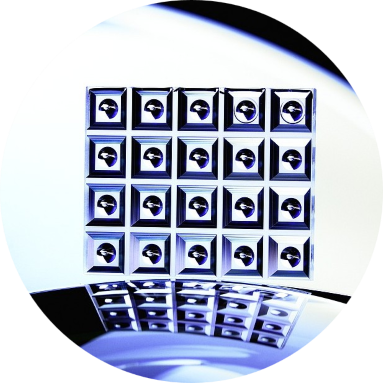
Custom MLAs with flexible geometry
The lenslets can be arranged linearly, two-dimensionally, or hexagonally. Round and rectangular apertures allow for adaptation to the geometry of the light source, detector, or optical channel. High fill factors and small dead zones ensure that a large proportion of the array area can be utilized optically.
In addition, complex aspherical meniscus designs with convex and concave surfaces are possible. Individual lenslets in a multichannel array can have different radii, focal lengths or optical functions. For example, multiple imaging or spectral channels can be combined in a monolithic glass array.
Technical Highlights:
Two-dimensional collimation and focusing
Efficient coupling of multiple channels
High fill factors and channel densities
Large and flexibly scalable channel counts
Reduced aberrations through aspheres
Flexible lenslet arrangements
Individual lenslets within an array
Complex convex-concave designs
Multispectral design
Uniform illumination
Präzise Systemintegration
Compact optical designs
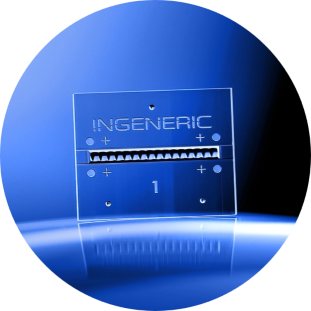
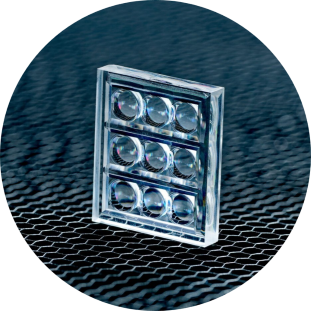
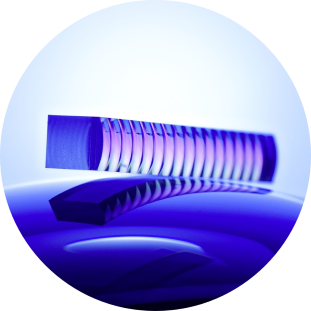
Focus on our spherical and aspherical MLAs
Choose from our standard products or contact us for a customized solution.
| Lens type | Size [mm] | QTY of lenslets | Arrangement | EFL [mm] | PE [mm] | D [mrad] | Material |
|---|---|---|---|---|---|---|---|
| MLA-SPH-PL-CX-0.70 | 5.0 x 4.0 x 0.577 | 16 | 1x16 | 0.70 | 0.25 | 0.25 | K-VC89 |
| MLA-ASPH-PL-CX-3.25 | 18.0 x 16.0 x 1.055 | 100 | 10 x 10 | 3.25 | 1.5 (PEx, PEy) | 1.5 | K-VC89 |
| MLA-SPH-PL-CX-3.2 | 10.0 x 10.0 | 40 | linear | 3.2 | 1.2 | 1.2 | K-VC89 |
| MLA-ASPH-PL-CX-0.72 | 15.0 x 12.0 | 20 | linear | 0.72 | 3.2 | 1.3 | K-VC89 |
| MLA-ASPH-PL-CX-2.28 | 8.0 x 6.0 | 9 | linear | 2.28 | 1.1 … 1.3 | 1.0 | L-BSL7 |
Material: Optical glass (material with a high refractive index)
Max. dimensions: approx. 45.0 x 45.0 mm
EFL: 0.25 … 5.0 mm
Lens diameter: 0.125 … 3.0 mm
Lens aperture: round, rectangular
Arrangement: linear, hexagonal
Number of lenses per array: 5 … 2000
Pitch: 0.125 … 4.0 mm
Pitch accuracy: < 2 µm over 25 mm
EFL tolerance:<1%*
Geometric accuracy: < 250 nm
Dead zones: <10 µm
Center thickness accuracy: < 20 µm
*) High relative radius tolerance (< 0.2%)

Isothermal Precision Glass Molding
Our manufacturing process offers numerous advantages:
Wafer-scale optics manufacturing for high volumes and cost-efficiency
Extremely tight manufacturing tolerances for precise optical properties
Precision molding for high geometric accuracy and uniformity
In-mold compression molding for high reproducibility of the optical shape
In-house metrology for inspecting optical and geometric properties
Automated assembly processes for reproducible optical alignment
Thermally stable optical glasses with low absorption
Great geometric freedom for custom designs
The result is micro-optics and lens arrays that offer series-production quality, stability, and excellent reproducibility.
Additional Services:
Custom lenslet geometries
Individual channel and array parameters
Multispectral design and coating
Alignment and mounting features
Development services
Quality
For spherical and aspherical arrays, the uniformity of pitch, radius, focal length, and shape is a decisive factor in optical performance. INGENERIC verifies these and other specification-relevant parameters using appropriate metrology and documents compliance with the agreed requirements.
Reproducible manufacturing supports consistent channel-to-channel performance, stable focal positions, and uniform imaging characteristics. Depending on the design, surface quality, center thickness, and transition zones can also be included in quality assurance.
Upon request, an application-specific test setup can be developed to evaluate collimation, imaging, or coupling functions under conditions that closely replicate the intended operational environment. This minimizes discrepancies between internal characterization and system-level measurements.
Frequently Asked Questions – FAQs
Where are INGENERIC products manufactured?
How does a custom development project proceed?
What are NRE costs?
Is volume production possible?
This enables efficient production of both prototypes and high-volume series with consistent quality.

Get in Touch!
INGENERIC – Your Partner for Precision Optical Solutions
Do you have suggestions, specific requirements, or a concrete enquiry? We can help you select the right micro-optics for your application—from standard components to customised solutions. Please feel free to contact us for personal advice or an individual quotation.
We look forward to hearing from you!