


INGENERIC MLAs
Microlens arrays for collimation, homogenization, and light coupling
- INGENERIC Home
- Industries
- Microlens arrays
INGENERIC MLA
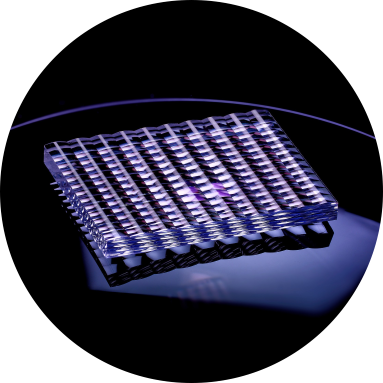
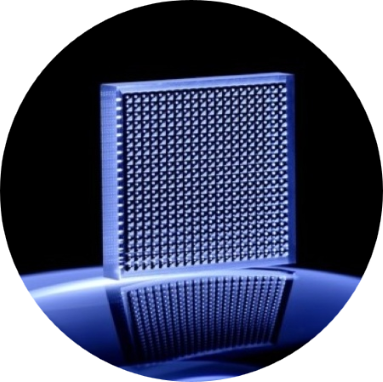
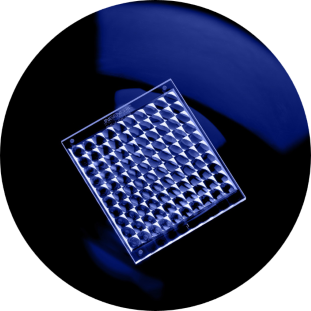
INGENERIC microlens arrays are precision micro-optics made of optical glass that combine multiple precisely positioned lens elements into a single monolithic component. They are used to selectively collimate, homogenize, focus, or transform light, or to efficiently couple it into optical systems. This makes them suitable for demanding optical systems requiring multiple channels, compact designs, and reproducible optical properties.
The arrays can be implemented as 1D or 2D microlens arrays. Optical functions can be tailored to the specific application through the precise tuning of focal length, pitch, aperture, lens geometry, and array layout.
INGENERIC MLA
INGENERIC manufactures custom microlens arrays featuring spherical, aspherical, cylindrical, acylindrical, and toric lens geometries. Depending on the design, plano-convex, biconvex, and convex-concave geometries are possible. Apertures can be circular or rectangular, and the lens arrangement may be linear, two-dimensional, or hexagonal. Individual array structures typically fall within the sub-millimeter range, while the overall array size is adapted to the specific optical system; total dimensions of up to 50 x 50 mm² are possible.
Thanks to their monolithic glass structure, microlens arrays combine high optical precision with robust mechanical and thermal stability. They facilitate compact system architectures, reduce the effort required for assembly and alignment compared to solutions using numerous individual lenses, and ensure reliable performance in series production.
Technical Highlights:
Glass MLAs offer a precise, compact and mass-producible solution for optical systems with multiple channels or recurring optical functions. Crucial here are not only the optical properties of individual lenses but also the uniformity across the entire array.
Precise
light shaping
High channel-to-channel uniformity
Low pitch errors for precise beam positioning
Minimal dead zones
Monolithic glass structure
High design flexibility
Compact integration
High reproducibility
Optical efficiency
Isothermal Precision Glass Molding
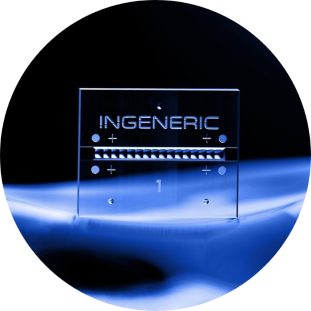
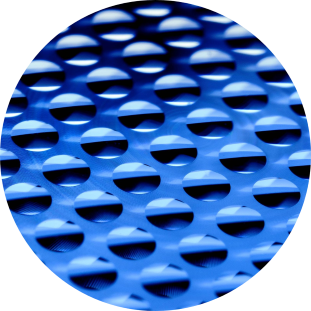
Our manufacturing process offers numerous advantages:
Wafer-scale optics manufacturing for high volumes and cost-efficiency
Extremely tight manufacturing tolerances for precise optical properties
Precision molding for high geometric accuracy and uniformity
In-mold compression molding for high reproducibility of the optical shape
In-house metrology for inspecting optical and geometric properties
Automated assembly processes for reproducible optical alignment
Thermally stable optical glasses with low absorption
Great geometric freedom for custom designs
The result is micro-optics and lens arrays that offer series-production quality, stability, and excellent reproducibility.
Additional Services:
Custom optical design
Design-in phase for precision glass molding
Prototypes to serial production
Coatings and optical surface functions
Markings and alignment features
Dicing, cleaning, and inspection
Alternative optical combinations and modules
Quality
INGENERIC relies on rigorous quality management and comprehensive metrological testing of relevant product characteristics. Depending on the specifications, these include—among other parameters—pitch, radius, focal length, form error, center thickness, surface quality, and transition zones. This ensures that the manufactured microlens arrays reliably meet the defined optical and geometric requirements.
INGENERIC possesses extensive metrology equipment for quality assurance purposes. Relevant parameters can be monitored and documented on a project-specific basis and compared against the requirements of the intended application. Upon request, a custom test setup can also be implemented to verify optical characteristics under conditions simulating actual use, thereby minimizing discrepancies between laboratory testing and final deployment.
Combined with reproducible manufacturing technology, the result is glass optics offering consistent series quality, uniform optical properties, and reliable performance. This makes INGENERIC microlens arrays suitable for applications where precise collimation, homogeneous light distribution, stable coupling, and long-term reproducible system performance are critical.
Frequently Asked Questions – FAQs
What advantages does the precision blank molding process offer?
How does a custom development project proceed?
What are NRE costs?
At INGENERIC, the cost of refurbishing tooling due to wear is included in the product pricing.

Get in Touch!
INGENERIC – Your Partner for Precision Optical Solutions
Do you have suggestions, specific requirements, or a concrete enquiry? We can help you select the right micro-optics for your application—from standard components to customised solutions. Please feel free to contact us for personal advice or an individual quotation.
We look forward to hearing from you!