


INGENERIC Collimation Modules
Compact fast- and slow-axis collimation for high-power diode lasers
- INGENERIC Home
- Industries
- Collimation Modules
Integrated collimation for precise laser beam shaping
INGENERIC C-modules are compact glass collimation modules that reduce the divergence of diode laser beams in both the fast and slow axes simultaneously. They combine two precisely matched micro-optics into a pre-assembled module, thereby enabling efficient, reproducible beam collimation within a single component.
The modular design allows for the optimal alignment of fast- and slow-axis collimators. The result is a space-saving, easy-to-install solution for applications where high beam quality, stable alignment, and suitability for industrial mass production are paramount—such as in pump modules, free-beam systems, or OEM laser platforms.
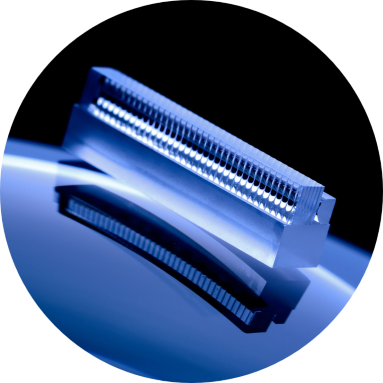
Technical Highlights:
INGENERIC C-modules address the key challenges of modern diode laser systems. The advantage: Precise beam collimation with minimal integration effort.
Simultaneous fast- and slow-axis collimation
Compact and integrated design
Dimensions
Lengths from 2 mm to 20 mm possible
High optical efficiency
Optimized beam quality
Pre-assembled module
Assembly accuracy
High reproducibility
Predefined optical distance
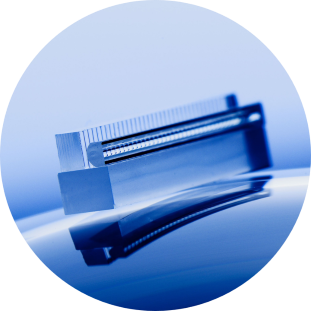
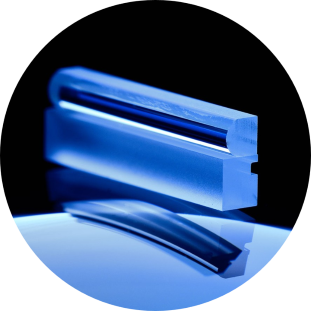
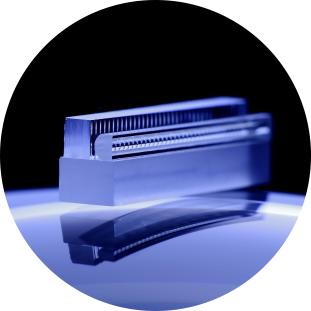
An overview of our C-modules
Choose from our standard products or contact us for a customized solution.
| Module | EFLSAC [mm] | BFLFAC [mm] | EFLFAC [mm] | PE [mm] | L [mm] | H [mm] | T [mm] | D [mrad] |
|---|---|---|---|---|---|---|---|---|
| C-600-022-500 | 2.20 | 0.15 | 0.60 | 0.50 | 13.00 | 1.00 | 2.70 | 1.20 |
| C-900-022-500 | 2.20 | 0.09 | 0.90 | 0.50 | 13.00 | 1.50 | 3.50 | 0.80 |
| C-600-026-500 | 2.60 | 0.15 | 0.60 | 0.50 | 13.00 | 1.00 | 2.70 | 1.20 |
| C-900-026-500 | 2.60 | 0.09 | 0.90 | 0.50 | 13.00 | 1.50 | 3.50 | 0.80 |
| C-600-030-500 | 3.00 | 0.15 | 0.60 | 0.50 | 13.00 | 1.00 | 3.69 | 1.20 |
| C-900-030-500 | 3.00 | 0.09 | 0.90 | 0.50 | 13.00 | 1.50 | 4.00 | 0.80 |
| C-600-035-1000 | 3.50 | 0.15 | 0.60 | 1.00 | 13.00 | 1.00 | 4.15 | 1.20 |
| C-900-035-1000 | 3.50 | 0.09 | 0.90 | 1.00 | 13.00 | 1.50 | 4.46 | 0.80 |
| C-900-060-1000 | 6.19 | 0.09 | 0.90 | 1.00 | 13.00 | 1.50 | 7.00 | 0.80 |
| C-900-069-1000 | 6.90 | 0.09 | 0.90 | 1.00 | 13.00 | 1.50 | 7.90 | 0.80 |
EFL: Effective focal length @ 808 nm
BFL: Back focal length @ 808 nm
PE: Pitch of emitter
Coating: Standard AR 780-1020 nm
Transmission: > 98%
L: Length [+/-0.10 mm) according to customer specification
H: Height (+/- 0.05 mm)
CT: Center Thickness (+/- 0.05 mm)
Material: SUMITA optical glass
Final SA divergence < 2w0/EFL
Quality specification for diode with FA divergence of 35° (FWHM),
SA divergence of 11° (FWHM) and 150 µm emitter width.

Isothermal Precision Glass Molding
Our manufacturing process offers numerous advantages:
Wafer-scale optics manufacturing for high volumes and cost-efficiency
Extremely tight manufacturing tolerances for precise optical properties
Precision molding for high geometric accuracy and uniformity
In-mold compression molding for high reproducibility of the optical shape
In-house metrology for inspecting optical and geometric properties
Automated assembly processes for reproducible optical alignment
Thermally stable optical glasses with low absorption
Great geometric freedom for custom designs
The result is micro-optics and lens arrays that offer series-production quality, stability, and excellent reproducibility.
Additional Services:
Alternative optics combinations with an expanded FAC and SAC portfolio
Flexible assembly and delivery options
Adjustment of optical and mechanical parameters
Optimized coatings
Automated assembly processes
Custom projects
Quality
Reliable quality for industrial series applications.
The C-modules are designed for stable, reproducible performance in industrial applications. Precise manufacturing processes, defined assembly procedures, and rigorous quality controls ensure that every module meets the required optical performance.
The combination of glass micro-optics, a stable modular architecture, and quality-assured manufacturing ensures consistent beam collimation throughout the entire product lifecycle.
Frequently Asked Questions – FAQs
Why micro-optics made of high-quality glass?
- outstanding thermal and mechanical stability
- significantly lower absorption and thus a longer service life
- perfect dimensional stability even at high power levels
- consistent optical performance throughout the entire operating life
- high surface quality (without polishing)
- Excellent scalability for mass production: precision blank pressing delivers identical optics in large quantities at economical costs
- Pressed glass is resistant to heat and radiant power
- The pressing process allows for complex surfaces with high precision.
What advantages does automated assembly offer?
The use of modern camera systems ensures the highest level of precision and reproducibility. Unlike manual handling, there is no risk of damage caused by assembly tools. Positioning accuracy is in the micrometer range.
Furthermore, assembly and packaging take place in a clean environment. The packaging is designed to be suitable for automated parts removal.
Which wavelength ranges/coatings are offered?
We would be happy to provide you with coating curves illustrating the transmission or reflection across the various ranges.
The standard coating is generally included in the product price. We may charge a fee for custom coatings.
Special coatings, such as dielectric or metallic coatings, are available upon request.

Get in Touch!
INGENERIC – Your Partner for Precision Optical Solutions
Do you have suggestions, specific requirements, or a concrete enquiry? We can help you select the right micro-optics for your application—from standard components to customised solutions. Please feel free to contact us for personal advice or an individual quotation.
We look forward to hearing from you!