


INGENERIC Aspheres & Spheres
Microlenses for high-performance optical systems
- INGENERIC Home
- Industries
- Aspheres & Spheres
Aspheres and spheres for optical precision
INGENERIC aspheric and spherical lenses made of optical glass are designed for applications where supreme precision, compact designs, and reproducible series performance are critical.
Aspheric glass lenses enable the targeted correction of optical aberrations and significantly improve imaging and collimation performance compared to purely spherical lenses. In many cases, multiple spherical elements can be replaced by a single glass asphere. This reduces space requirements, weight, and system complexity while simultaneously increasing efficiency.
We manufacture these precision optics in various geometries and dimensions – ranging from the sub-millimeter scale to lateral dimensions typically between 2 mm and 40 mm. The product range includes standard spheres and rotationally symmetric aspheres, as well as concave and convex aspheres.

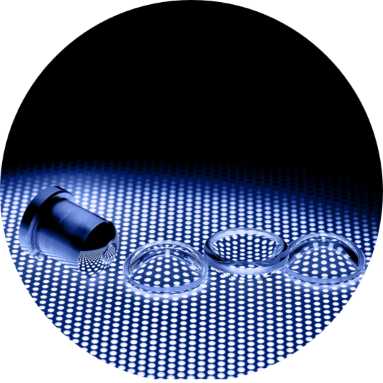
In addition to rotationally symmetric designs, toric geometries, free-form surfaces, and custom-defined 3D contours can be realized. Single- or double-sided structuring, aspheric configurations, and tailored lateral contours offer a high degree of design freedom, enabling precise adaptation to the specific application, available installation space, and optical requirements.
Custom optical design allows the diameter, contour, and optical parameters to be precisely tailored to the specific application. In addition, application-specific AR coatings and masking options are available.
We support projects from the development phase and prototyping through to scalable series production.
Technical Highlights:
Minimized aberrations & high image quality
Reduced number of lenses and compact systems
High numerical aperture (NA)
Concave and convex glass aspheres
Toric geometries and free-form surfaces
Sub-millimeter-scale micro-optics


Overview of our aspheres and spheres for collimation
Choose from our standard products or contact us for a customized solution.
| Lens Type | λ (nm) | D (mm) | Aperture CT (mm) | NA EFL (mm) | BFL (mm) | Form accuray | Material | ||
|---|---|---|---|---|---|---|---|---|---|
| ASPH-PL-CX-2.4 | 785 | 4.2 × 4.2 | Rectangular | 2.0 | 0.8 | 2.4 | 1.25 | < 260 nm | K-VC89 |
| ASPH-PL-CX-6.5 | 1030 | 6.325 | Round | 2.3 | 0.33 | 6.5 | 5.23 | < 300 nm | K-VC89 |
| ASPH-PL-CX-0.75 | 1100 | 3.0 × 3.0 | Rectangular | 0.8 | 0.7 | 0.75 | 0.30 | < 600 nm | K-VC89 |
Overview of our aspheres and spheres for imaging
Choose from our standard products or contact us for a customized solution.
| Lens Type | λ (nm) | D (mm) | CA (mm) | Aperture | CT (mm) | EFL (mm) | Form accuracy | Material |
|---|---|---|---|---|---|---|---|---|
| ASPH-CX-CX-2.47 | 1210 | 4.0 | 3.2 / 3.0 | Round | 3.0 | 2.47 | < 300 nm | K-VC89 |
Overview of representative specifications
Choose from our standard products or contact us for a customized solution.
| Lens Type | D (mm) | Aperture | CA (mm) | CT (mm) | Vertex ROC 1 (mm) | Vertex ROC 2 (mm) | SAG (mm) | Max slope angle (°) | Sagitta deviation (µm) | Form accuracy |
|---|---|---|---|---|---|---|---|---|---|---|
| Meniscus aspherical | 2.40 | Round | 1.8 / 1.2 | 0.4 ± 0.02 | 10.0 ± 2% | -0.75 ± 0.4% | 0.20 / 0.44 | 22° / 62° | < 0.8 / < 2.0 | < 250 nm PV |
| Bi-CX lens aspherical | 3.75 | Round | 3.0 / 3.0 | 1.7 ± 0.02 | 13.0 ± 1% | 9.0 ± 0.7% | 0.15 / 0.15 | 5° | < 0.9 / < 0.9 | < 250 nm PV |
| Meniscus aspherical | 24.00 | Round | 23 / 22 | 7.25 ± 0.05 | 21.0 ± 0.2% | -80.0 ± 0.2% | 5.64 / 4.92 | 46° / 6° | < 8.0 / < 1.5 | < 160 nm PV |
| Plano-CX aspherical | 35.00 | Round | 24 / 24 | 5.0 ± 0.1 | ∞ | 40.0 ± 0.1% | 3.92 | 25° | < 1.4 / < 2.0 | < 500 nm |
Material: optical glass (high index)
Lens diameter (D): 1.5 mm – 40.0 mm
Diameter (D) tolerance (molded): < 0.025 mm
Lens aperture: round, rectangular
Center Thickness (CT): 1.0 mm – 10.0 mm
CT tolerance: < 0.02 mm
max. Edge slope angle: < 65°
Radius (ROC) Accuracy: < 0,1 %
Form accuracy: < 100 nm PV (Irregularity)
Slope Error (mid frequency error): tbd. customer-specific
Surface Roughness: 2-5 nm rms
Cleanliness* (depends on lens size): 0.025 / 0.04 / 0.063 /… 0.4
*according to ISO 10110-7
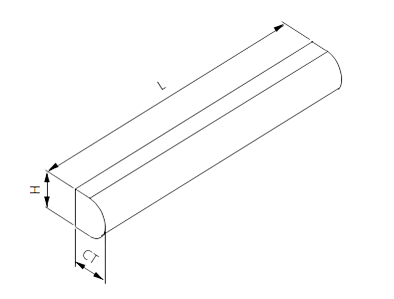
Diverse geometries for a wide range of optical applications
INGENERIC aspheres and spheres are available in numerous versions:
- Spheres for classical imaging and focusing tasks
- Rotationally symmetric aspheres for the correction of optical aberrations
- Single- or double-sided aspheric lenses for maximum design freedom
- Toric micro-optics for correcting different curvatures in two axes
- Freeform surfaces for highly integrated, custom optical systems
- Custom geometries and contours tailored to the requirements of your application: microstructures, ID codes, reference marks, etc. can be added and replicated.

Isothermal Precision Glass Molding
Our manufacturing process offers numerous advantages:
Wafer-scale optics manufacturing for high volumes and cost-efficiency
Extremely tight manufacturing tolerances for precise optical properties
Precision molding for high geometric accuracy and uniformity
In-mold compression molding for high reproducibility of the optical shape
In-house metrology for inspecting optical and geometric properties
Automated assembly processes for reproducible optical alignment
Thermally stable optical glasses with low absorption
Great geometric freedom for custom designs
The result is micro-optics and lens arrays that offer series-production quality, stability, and excellent reproducibility.
Quality
Comprehensive quality assurance is guaranteed throughout the entire manufacturing process. Every step – from the initial inspection of raw materials to the final inspection of the finished products – is monitored for quality and systematically documented.
If desired, a custom test rig can be implemented to ensure there are no deviations from the characteristics required for the intended application.
Frequently Asked Questions – FAQs
Why micro-optics made of high-quality glass?
- Outstanding thermal and mechanical stability
- Significantly lower absorption and therefore a longer service life
- Perfect dimensional stability even at high power levels
- Consistent optical performance throughout the entire operating life
- High surface quality (without polishing)
- Excellent suitability for mass production: precision blank pressing delivers identical optics in large quantities at a cost-effective price
- Pressed glass is resistant to heat and radiant power
- The pressing process allows for complex surfaces with high precision
What are the benefits of our automated assembly?
- Maximum precision and repeatability through the use of camera systems
- No risk of damage caused by manual handling or assembly jigs
- Positioning accuracy in the micrometre range
- Assembly and packaging in a cleanroom environment
- Packaging suitable for automated retrieval
How is pricing calculated for INGENERIC products?
Customized Products / Custom-Made Optics: For our precision glass molding process, dedicated tooling is required. Depending on the project and production volume, this may involve one or multiple molds or inserts, resulting in a one-time non-recurring engineering (NRE) and tooling cost. Product pricing is determined based on order volume, with higher quantities benefiting from lower unit prices.
Development costs depend on the complexity and size of the molds. In particular, smaller molds can often be realized more cost-effectively during the prototype or sampling phase. As projects progress toward serial production, unit costs can frequently be reduced through economies of scale. The one-time development costs also cover tooling maintenance and replacement, if required.

Get in Touch!
INGENERIC – Your Partner for Precision Optical Solutions
Do you have suggestions, specific requirements, or a concrete enquiry? We can help you select the right micro-optics for your application—from standard components to customised solutions. Please feel free to contact us for personal advice or an individual quotation.
We look forward to hearing from you!